

Dancewear is cut close to the body, so it notices changes quickly – often before you do. More training builds muscle, a break or a busy year changes your shape, teenagers grow, and adult bodies change too. A leotard that fitted perfectly last season may now dig in, slip or ride up, and shoes may press. A short fitting check at the start of each season helps you dance comfortably and spend money only where it is needed.

Why the fit changes
- Training: more classes or strength work change muscle tone, especially in the legs, back and shoulders.
- Breaks: an injury, exams or a busy period mean less training.
- Growth and life stages: teenagers grow, and adult bodies change too – for example after pregnancy or with age.
- The clothes themselves: elastic fibres tire with wear and washing, so a garment can fit differently even if you have not changed.
The leotard check
- Do a deep plié and a forward bend: does the leotard ride up, pull at the shoulders or dig in at the legs?
- Raise your arms: do the straps stay in place?
- Look in the mirror: does the fabric become thin or see-through when stretched?
The shoe check
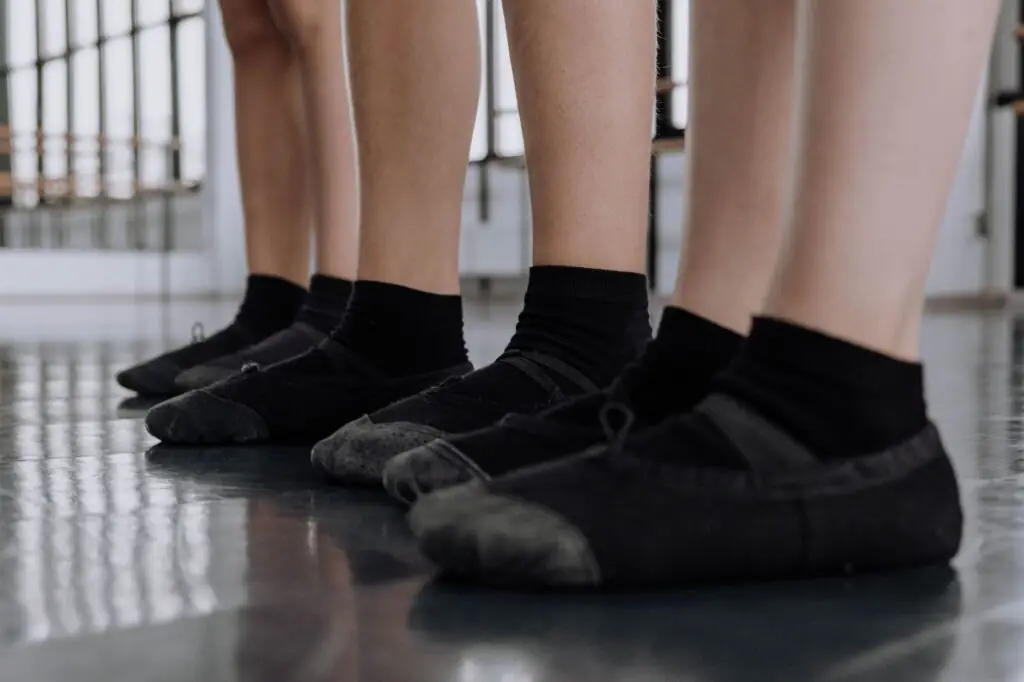
- Ballet slippers: toes lying flat, no empty space at the front, no pressure points; the drawstring should not be needed to keep them on.
- Ballroom shoes: a stable heel, no pressure on the little toe, straps that do not cut in after a long practice.
- Half shoes for rhythmic gymnastics: no folds under the sole, elastic that holds firmly.
If in doubt, measure your foot length again – feet can change in adulthood too. More: how to try on dancewear and dance shoes.
Fabric and style
If your training has changed, your dancewear may need to change as well: a cotton-rich leotard can be comfortable in a relaxed class but stretch out in long sessions, while a synthetic stretch fabric keeps its shape better – see the dancewear fabric cheat sheet. A new style may also need different clothes and shoes.
Replace, adjust or keep?
- Replace: shoes that press or slip, leotards that have become see-through, tights with runs, elastic that no longer recovers.
- Adjust: straps can often be shortened, and elastics on shoes re-sewn.
- Keep: warm-ups and loose layers usually adapt to small changes.
No need to judge your body
A change in size is not a failure; it is simply information for choosing the right dancewear. Dancewear should fit the body you have today – not the one you had last year or hope to have next year.
For children who keep growing, see dancewear for growing kids.
FAQ
How often should I check whether my dancewear still fits?
At least at the start of each season, and whenever something starts to press, slip or ride up.
How do I know if my dance shoes are too small?
Your toes are bent or pressed, you feel pressure points, or the shoes hurt after a short time. Measure your foot length and compare it with the size chart.
Why does my old leotard suddenly feel uncomfortable?
Either your body has changed or the elastic in the fabric has worn out – often a bit of both.


