
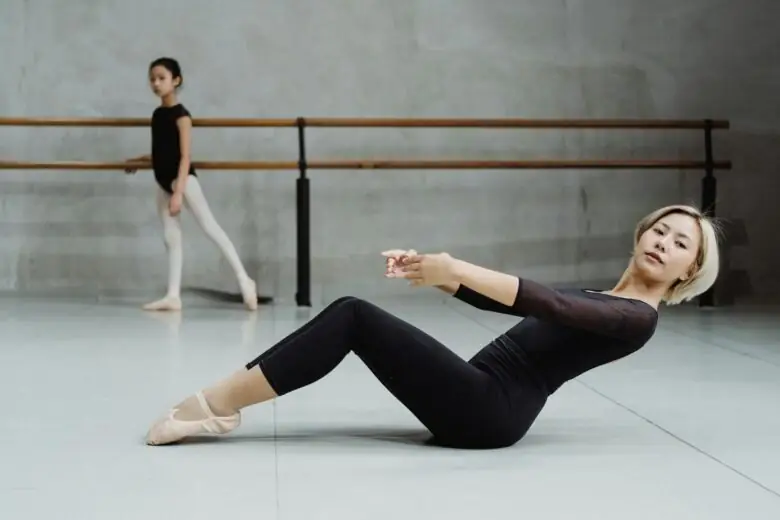
Dancers think about feet, arms, turnout and timing – but rarely about breathing. Yet many hold their breath in balances, jumps and difficult combinations, and then wonder why they are out of breath after a short variation or look stiff on stage. Breathing is not a special technique reserved for professionals. You can practise it like any other part of dancing.

Why breathing matters in dance
- Stamina: holding your breath makes you tire faster and leaves you gasping at the end of a combination.
- Control and balance: steady breathing keeps the upper body calmer; breath-holding tends to stiffen the shoulders and neck.
- Movement quality: breath gives movements a beginning and an end – it is part of phrasing and musicality.
- Nerves: slow breathing, especially a longer exhale, helps many dancers calm down before going on stage.
Common breathing mistakes
- Holding your breath in balances, adagio and before jumps.
- Breathing high in the chest with lifted shoulders.
- Pulling the stomach in so hard that there is no room to breathe – engaging the core and breathing are not opposites.
- Gasping big breaths through the mouth at the end of every phrase.
Chest, belly or ribs?
When you breathe in, the ribs can widen to the sides and back while the abdominal muscles stay gently active. This lateral or rib breathing, familiar from Pilates, suits dance well: it lets you breathe without losing your centre. Deep belly breathing with fully relaxed abdominals is useful for relaxing, for example after class, but less practical in the middle of a combination. Shallow breathing high in the chest is the pattern to avoid.
A five-minute breathing routine
- Feel the ribs (1 minute): place your hands on your lower ribs, breathe in through the nose and feel the ribs widen into your hands; breathe out slowly through the mouth.
- Breathe while engaged (1 minute): stand in parallel, gently draw in the lower abdomen and keep breathing into the sides of the ribs.
- Breath and movement (2 minutes): do slow pliés and port de bras – breathe in as you go down or open, and out as you rise or close. Then try it the other way round and notice the difference.
- Calm exhale (1 minute): breathe in for four counts and out for six to eight counts.

Breath in the choreography
Many dancers find it helpful to plan breathing like any other part of the choreography. Find the places where you can breathe in – often in a preparation or a moment of stillness – and breathe out on the effort, for example as you push off for a jump or rise into a balance. If you are unsure where to breathe in a variation, ask your teacher. In rhythmic gymnastics routines it works the same way: find the natural pauses and use them.
Breathing and stage presence
An audience can see a held breath: the neck tightens, the shoulders rise and the face freezes. Breathing through a movement makes it look easier and more alive. Before you go on stage, a few slow breaths with a long exhale help to calm the nerves – see how to prepare backstage.
FAQ
Should dancers breathe through the nose or the mouth?
Both are fine. In calm moments, breathing in through the nose helps you breathe more slowly; in intense combinations you will naturally breathe through the mouth as well.
Why do I run out of breath so quickly when dancing?
Often because you hold your breath during difficult steps, and sometimes because your stamina needs building up. Practise breathing on purpose and add some cardiovascular training – see cross-training for dancers.
Does breathing affect balance?
It can. Holding your breath tends to make the upper body stiff; calm, steady breathing helps you stay centred and make small adjustments in a balance.


