
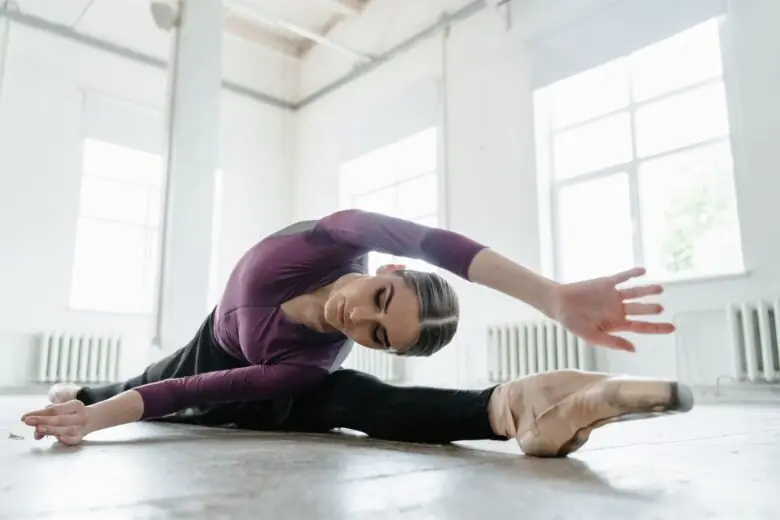
Leggings are worn in contemporary, jazz and hip-hop classes, for warm-ups and stretching, and in rhythmic gymnastics training. But not every pair of sports leggings works for dance. Dancers bend, split, roll on the floor and turn, so the fabric and cut have to do more than on a jog. Six simple tests help you choose a pair that lasts – and you can do most of them in the fitting room.

Leggings or tights?
Many ballet schools ask for tights and a leotard in class, so that the teacher can see the line of the legs; leggings are then for warm-ups only. In contemporary, jazz, hip-hop and rhythmic gymnastics training, leggings are common. Check your school’s dress code first – see dance class dress codes. If you need tights, read how to choose dance tights.
Test 1: the squat test
Do a deep plié or squat in front of a mirror in good light. If the fabric becomes see-through, it is too thin – or the size is too small and the fabric is overstretched. Dark colours hide more, but the test applies to every colour.
Test 2: the waistband
Bend forward, lie on your back and lift your legs. A good waistband stays in place without rolling down or digging in. Wide, high-rise waistbands usually stay put better than narrow elastic.
Test 3: seams and gusset
Flat seams do not rub when you sit or roll on the floor. A gusset – an extra panel of fabric between the legs – gives freedom of movement in splits and stops the crotch seam from pulling.
Test 4: the fabric
- Synthetic stretch fabrics (polyamide or polyester with elastane) keep their shape, dry quickly and glide well on the floor.
- Cotton-rich fabrics are soft and breathable, but can stretch out at the knees and seat during a long class.
- Thermal leggings with a brushed inside keep muscles warm in cold halls and during warm-ups.
More on materials: the dancewear fabric cheat sheet.
Test 5: length and feet
- Full-length leggings keep the legs warm and protect the knees on the floor.
- Capri and 7/8 lengths show the line of the ankle and do not get under your feet.
- Stirrup leggings have a strap under the foot, so they do not ride up in jumps and stretches – popular in rhythmic gymnastics and jazz.
Whatever the length, the hem should not bunch around the ankle or slip under the heel when you dance barefoot or in half shoes.
Test 6: the wash test
Read the care label before you buy. Most dance leggings last longer if you wash them inside out at a low temperature without fabric softener, and dry them on a rack rather than in the tumble dryer. Heat and softener wear out elastic fibres. More tips: how to wash dancewear.
What do dance leggings cost?
In our shop you will find leggings for dance and rhythmic gymnastics – full-length, capri, stirrup, thermal and cotton models from brands such as Tuloni, Sasaki and Chacott – for about CHF 15 to 40.
FAQ
Can I wear leggings to ballet class?
It depends on the school. Many ask for tights in class and allow leggings only for warm-ups. Ask your teacher.
What size dance leggings should I choose?
Snug but not squeezing. If you are between sizes, try both: leggings that are too tight become see-through when you bend.
Are leggings for rhythmic gymnastics different?
They are often more fitted, with stirrups and decorative details for training and shows. Read our guide to leggings for rhythmic gymnastics.


