
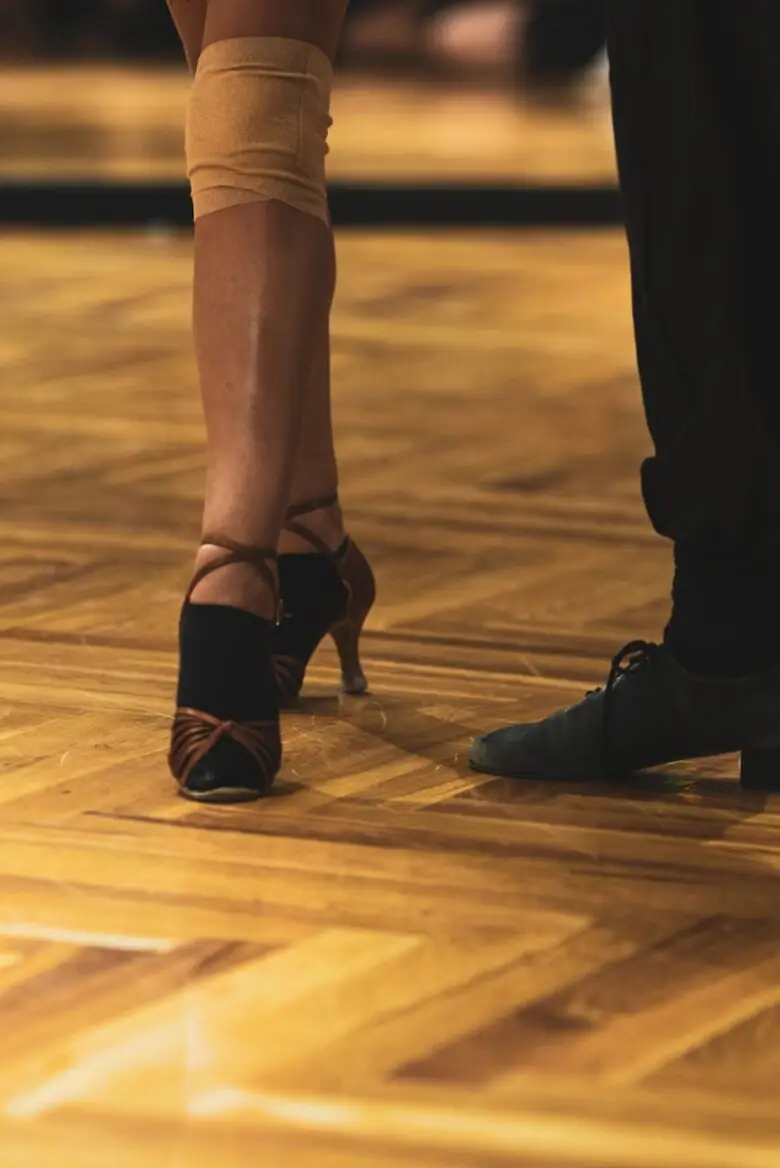
You roll out a new practice floor in the living room, try your first pirouette – and slide. The wrong practice floor can hurt your technique, your joints and your budget at the same time. Marketing photos of dancers gliding across shiny surfaces do not show what is underneath, and the layer underneath matters most. This guide compares portable and permanent options, what they cost and which one fits your situation.
Why your practice surface matters more than your shoes
You would not train for a marathon on a trampoline. Yet dancers often practise on carpet, concrete, tiles or laminate – surfaces that either grip too much or are slippery and hard. A proper dance floor does two things at once: its surface gives controlled slip for turns and footwork, and the subfloor absorbs shock and protects the joints from repeated landings.
One rehearsal on concrete will not injure you. But week after week, jumps on a hard floor add up in the shins, knees and lower back. That is why studios use sprung floors, and why the subfloor deserves a bigger share of your budget than the surface on top.
Portable floors: freedom with a catch
Portable dance floors suit dancers who rent, travel or have no dedicated studio space. But “portable” covers very different products:
- Roll-out vinyl or Marley sheets – the cheapest way to get a proper dance surface. Good slip control, but almost no shock absorption on their own: fine for barre and light work, not for jumps.
- Foam-backed vinyl – a Marley-type surface with a foam layer underneath. A little more cushioning, but still not a sprung floor.
- Interlocking foam tiles – popular for fitness and hip-hop. Too soft for pointe work and turns: think yoga mat rather than studio.
- Portable sprung panels – panels with a built-in shock-absorbing layer, topped with Marley. The closest thing to a real studio floor, but heavier and more expensive.
The most common mistake is laying a Marley sheet directly on concrete or tiles: you get the right surface but none of the shock absorption.

Permanent sprung floors: an investment in your joints
If you own your space – a home studio, a converted garage or a basement – a permanent sprung floor makes a real difference. There are three main types:
- Basket-weave subfloors – layers of plywood laid in alternating directions on foam or rubber pads. Many professional studios use this system.
- Floating floor systems – pre-made panels on a foam underlay. Easier to install yourself, slightly less responsive than a basket-weave floor.
- Custom sprung floors – joists with engineered give, topped with hardwood or Marley, as in theatres and top studios. Usually more than a home studio needs.
If you dance at home for several hours a week, a sprung floor is one of the most useful investments in your training space.
What does a sprung dance floor cost?
Prices depend on the country, the supplier, the size of the room and whether you install the floor yourself. Two published examples give an idea:
- The US floor supplier Stagestep quoted in 2020 about $8.50 per square foot (around $90 per m²) for a complete studio system: vapour barrier, sprung wood subfloor and heavy-duty Marley surface. Dance surfaces alone cost about $1.80 to $7.20 per square foot ($19 to $78 per m²), and small home practice boards with a built-in subfloor around $100 to $150 (source).
- The UK cost guide Checkatrade gives £30 to £100 per m² for sprung flooring (typically about £65 per m²) and £30 to £55 per m² for portable dance floor tiles (source).
For a small home studio of 3 × 4 m (12 m²), that means roughly £360 to £1,200 for sprung flooring by the UK guide, or about $1,100 for a complete system at Stagestep’s 2020 prices – before delivery and installation. In Switzerland, ask local suppliers for a written quote in CHF that includes delivery, and compare prices per square metre.
Portable vs. permanent: comparison
| Feature | Marley sheet on a hard floor | Portable sprung panels | Permanent basket-weave | Permanent floating system |
|---|---|---|---|---|
| Shock absorption | Minimal | Good | Very good | Good |
| Surface for turns | Good | Good | Very good | Good |
| Set-up | Minutes | Up to an hour | Permanent | Permanent |
| Cost | Lowest | Medium to high | Highest | Medium |
| Portability | High | Medium | None | None |
| Best for | Light barre work in a flat | Renters and travelling dancers | Home studios, serious training | Home owners on a budget |
A cheap sheet that you replace every few years is not always cheaper in the long run: a permanent floor costs more at the start, but it lasts much longer.

The hidden factor: noise and neighbours
Impact noise is the factor most comparisons forget, and it matters a lot if you live in a flat. A Marley sheet on concrete does almost nothing against impact sound, while panels on an elastic underlay reduce it noticeably. If you live in a multi-unit building:
- Add a sound-insulating layer, such as mass-loaded vinyl, under a portable system.
- Choose panels on rubber pads rather than soft foam: rubber usually damps impact better.
- Agree practice times with your neighbours. Goodwill costs nothing.
So what should you buy?
- If you rent and move often: portable sprung panels with a Marley surface. Heavy and not cheap, but they move with you.
- If you own your home and dance regularly: a floating floor system with Marley on top – a realistic DIY project for a small room.
- If your budget is tight: foam-backed vinyl, or a Marley sheet on a suitable underlay, is better than Marley directly on concrete. Keep the jumps for the studio.
- If you are buying for a young child: for recreational classes, a simple Marley sheet for positions and light choreography is enough. The bigger investment can wait until training and jumps increase.
The best dance floor is the one you actually use. A small, well-built practice area you use four evenings a week is worth more than an expensive system collecting dust. Setting up a home studio? See also our guide to dance mirrors for home studios.
Need new class gear? Take a look at our ballet leotards and ballet skirts.


